Simon Says: History, Rules and 50 Commands
Where Simon Says comes from: it was already a known children's game in 1840s Boston. Its origin, how it spread, the rules and 50 commands.
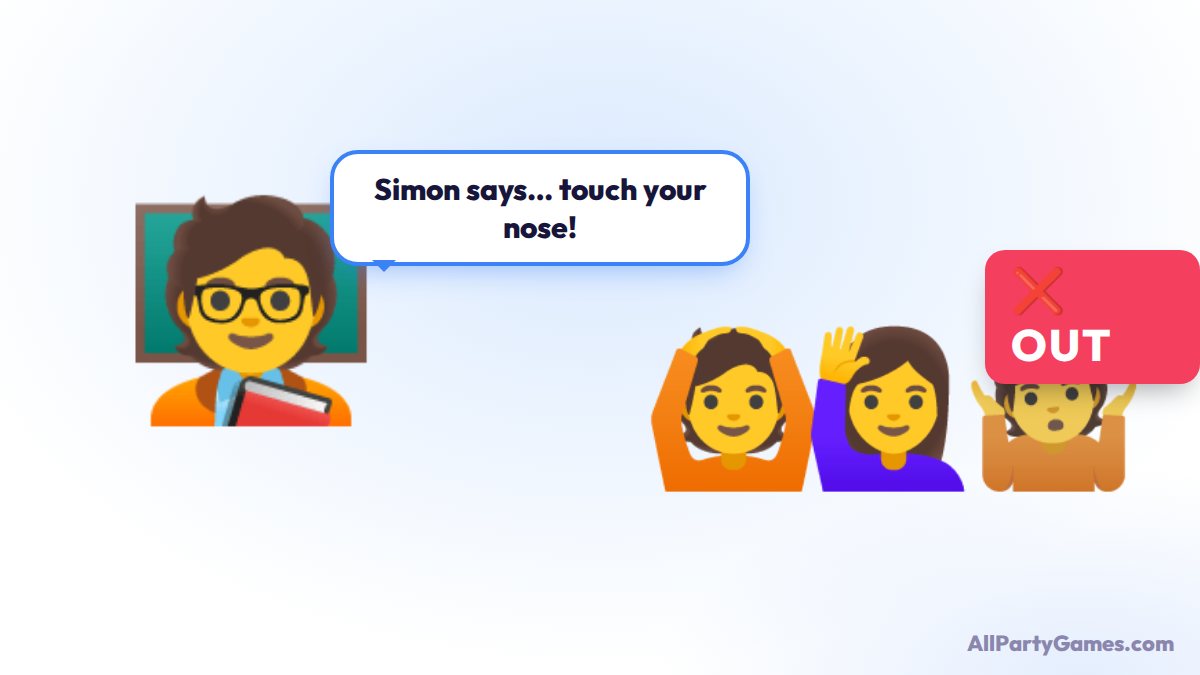
"Simon says touch your nose. Simon says hop. Touch your toes!" — and half the room is out. Simon Says is the simplest listening game ever invented, and it still catches adults out at parties.
Where does Simon Says come from?
The game is much older than most people assume. The earliest known printed reference found so far is in the Boston Morning Post of 25 April 1842, which joked that "Simon is a great talker; sometimes he says 'up,' sometimes he says 'down,' and sometimes he says 'wiggle waggle'." Six years later a Pittsburgh newspaper described "the youth's game of 'Simon says up, Simon says down, wiggle waggle'" — by 1848 the game was familiar enough to be used as a political joke. Who Simon was, nobody knows.
The same game exists across the world with a different leader. French children play Jacques a dit ("James said"), Irish and British children also know O'Grady says, Turkish children obey Yakup der ki (Jacob says), and in Lebanon the commands come from "the teacher". Sweden has a related "do this, do that" version where the trap is the phrase itself.
What you need
- Nothing — a leader and a group.
- For a screen-run version, our Simon Says game master announces commands out loud, mixes in traps and lets the host tap out anyone who slips, so the adult can play instead of leading.
How to play Simon Says
- One player is Simon and stands facing the group.
- Simon gives commands. A command that starts with "Simon says" must be obeyed: "Simon says jump."
- A command without "Simon says" must be ignored: "Jump." Anyone who follows it is out.
- Simon speeds up, repeats commands, and mixes real and fake ones.
- The last player still in wins and becomes the next Simon.
50 command ideas
Kids: touch your nose, hop on one foot, spin around, clap twice, sit down, stand up, wiggle your fingers, make a silly face, roar like a lion, flap your arms, touch your knees, march on the spot, freeze, pat your head, rub your tummy, point to the door, wave hello, blink fast, stick out your tongue, tiptoe.
Family: do a star jump, walk like a crab, high-five a neighbour, say your name backwards, hum a tune, do three squats, balance on one leg, pretend to swim, pretend to sleep, moonwalk.
Party: do the robot, strike a pose, sing a line of any song, do your best celebrity impression, shake hands with two people, do a slow-motion run, air guitar, do a curtsy, applaud yourself, freeze in a superhero pose, whisper "Simon is the best", touch something blue, swap places with someone, do a dramatic sigh, pretend to be a chicken, hold a plank, take a selfie pose, do the floss, laugh like a villain, take a bow.
Rules and variations
- Speed round — commands every two seconds.
- Silent Simon — Simon only mimes, and "Simon says" is replaced by a hat on or off.
- Team Simon — two teams, the last team with anyone standing wins.
- Reverse Simon — obey only the commands without "Simon says" (surprisingly hard).
Tips for hosts
- Start slow and obvious, then speed up; the traps work best when everyone is confident.
- Make the fake commands physically similar to the real ones ("Simon says touch your ear… touch your other ear").
- For very young children, do not eliminate — just point and laugh together, then continue.
Play Simon Says now — free, no sign-up
Play Simon Says online: the screen (and browser voice) calls random commands — only follow the ones that start with "Simon says". Kids, Family, Funny and Active command packs with Easy to Hard trap rates.
Frequently asked questions
Why is the game called Simon Says?
The name was already in use in the United States by 1842, when a Boston newspaper joked that "Simon is a great talker; sometimes he says up, sometimes he says down." Who the original Simon was is unknown.
What is Simon Says called in other countries?
In France it is "Jacques a dit", in Ireland and Britain you will also hear "O'Grady says", in Turkey "Yakup der ki" (Jacob says) and in Spanish "Mando".
What age is Simon Says for?
From about three years old. Toddlers love the copying; older children love the trap commands. Adults play it as a fast elimination game at parties.