Pin the Tail on the Donkey: How to Play and Where It Began
"Donkey parties" swept the United States from Milwaukee in the winter of 1886–87, and a Philadelphia printer copyrighted the first paper version in 1887. The history, the rules, safe variations and a screen version with no pins.
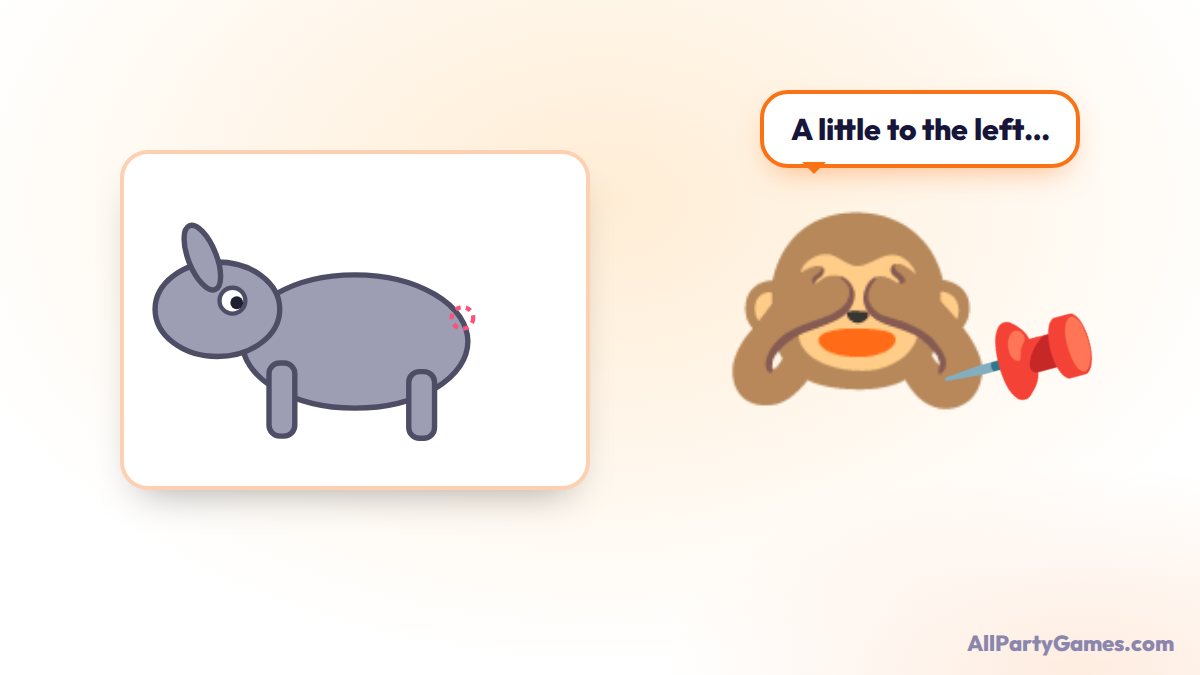
A donkey with no tail, a blindfold and a room full of people shouting "left! no, your other left!" — Pin the Tail on the Donkey has been the birthday game for more than a century, and it started life as a craze among adults.
Where does Pin the Tail on the Donkey come from?
The game arrived as a fad. In the winter of 1886 "donkey parties" were the newest social event in Milwaukee, Wisconsin: The Sun of New York reported on 27 December 1886 that "a large silhouette representing a tailless donkey is cut out of paper or cloth and fastened upon the wall", and a Washington paper repeated the story the next day. Through early 1887 the craze spread across the United States, hosted by women's clubs and charity socials. A Philadelphia printer, Charles Zimmerling, obtained a copyright on a printed paper donkey-and-tail set in 1887 and advertised it to stationers in 1888 as "properly drawn" and ready to use — the first commercial version. Within a generation it had migrated from adult parlours to children's birthdays, where it has stayed. Japan's New Year game fukuwarai, in which blindfolded players place facial features on a blank face, is a charming cousin.
What you need
- A picture of a tailless donkey, a tail per player with sticky tape or a pin, and a blindfold — or our pin-free Pin the Tail on the Donkey, an original cartoon donkey on the screen that goes dark and moves before you tap.
How to play
- Hang the donkey on a wall at the players' shoulder height.
- Blindfold the first player, hand them a tail and spin them round three times.
- Point them at the wall. They walk forward and stick the tail where they think it belongs.
- Write the player's name by their tail and repeat for everyone.
- The tail closest to the right spot wins.
Variations
- No-spin toddler version — just the blindfold.
- Team coaching — the team may shout directions; nobody may touch the player.
- Two-tail speed round — ten seconds to place both.
- Screen version — the donkey hides and shifts, and the distance is scored automatically; play on a TV with a phone as the controller.
Tips for hosts
- Use sticky tack or tape instead of pins for young children.
- Spin gently — dizziness is the game, falling over is not.
- Keep the reveal for the end: peel the blindfold off with everyone watching.
Play Pin the Tail on the Donkey now — free, no sign-up
Play Pin the Tail on the Donkey online: memorise the donkey, the screen goes dark (and the donkey moves), tap where the tail belongs and score by distance. Multiplayer, kid-friendly, original illustration.
Frequently asked questions
Who invented Pin the Tail on the Donkey?
It emerged as a "donkey party" fad in Milwaukee, Wisconsin, in late 1886 — a New York newspaper described it on 27 December 1886 — and Charles Zimmerling of Philadelphia copyrighted a printed paper version in 1887 that he advertised to stationers the following year.
Can you play it without a blindfold or pins?
Yes. Our screen version shows the donkey, hides it, sneaks it sideways and asks you to tap where the tail goes — no pins, no dizziness, and it scores the distance automatically.
What age is it for?
From about three. Toddlers play without the spin; older children get spun and love the wobble.