Bingo, Tambola and Housie: A Short History
Bingo descends from Il Gioco del Lotto d'Italia (about 1530), became Le Lotto in French salons, a schoolroom teaching aid in Germany, "Housey-Housey" in Britain and Tambola in India. The history, the rules, the calls and how to run a game from a phone.
Numbers are called, tickets are marked, and someone eventually shouts "House!" — or "Bingo!", or "Full house!". Bingo is a five-hundred-year-old lottery that became a family game, a church fundraiser, a wedding-reception staple in India and a British national pastime.
Where does bingo come from?
The game's roots are in the Italian lottery Il Gioco del Lotto d'Italia, played from about 1530. It travelled to France as Le Lotto, a pastime of the aristocracy, and from there across Europe in the eighteenth century. Nineteenth-century Germany used a similar game, Tombola, in schools to teach children multiplication tables, spelling and even history. In the United States the modern version was popularised at carnivals and fairs in the 1920s — the promoter Hugh J. Ward is credited with the name "bingo" — and Edwin S. Lowe, who spread the game nationally, received the patent on the modern card design in 1942. In Britain the game was known as Housey-Housey and boomed after the Betting and Gaming Act of 1960; in India it became Tambola, the game of kitty parties, Diwali evenings and railway-station waiting rooms.
What you need
- Tickets or cards for the players and a caller. Our Tambola Number Caller (1–90) and Bingo Number Caller (1–75) draw the numbers, read them out and keep the board, so anyone can host.
- Pens or counters to mark numbers, and prizes for each pattern.
How to play
- Hand out tickets — Tambola tickets have three rows of five numbers; American cards are a 5×5 grid with a free centre.
- Announce the prizes: early five, top line, middle line, bottom line, four corners, full house.
- The caller draws numbers one at a time and reads them (with the nickname if you like).
- Players mark any number on their ticket.
- The first player to complete a pattern shouts; the caller checks the ticket against the called numbers and awards the prize.
Traditional calls
Kelly's eye (1), one little duck (2), cup of tea (3), knock at the door (4), man alive (5), legs eleven (11), unlucky for some (13), sweet sixteen (16), dancing queen (17), key of the door (21), two little ducks (22), duck and dive (24), half a crown (26), dirty Gertie (30), all the threes (33), droopy drawers (44), halfway there (45), clickety click (66), two fat ladies (88), top of the shop (90). Make up your own — "the birthday girl's age" is always a hit.
Variations
- Music Bingo — prompts instead of numbers; the host plays a matching song (Music Bingo).
- Picture bingo for toddlers.
- Word bingo for classrooms — vocabulary instead of numbers.
- Blackout — only a full card wins.
Tips for hosts
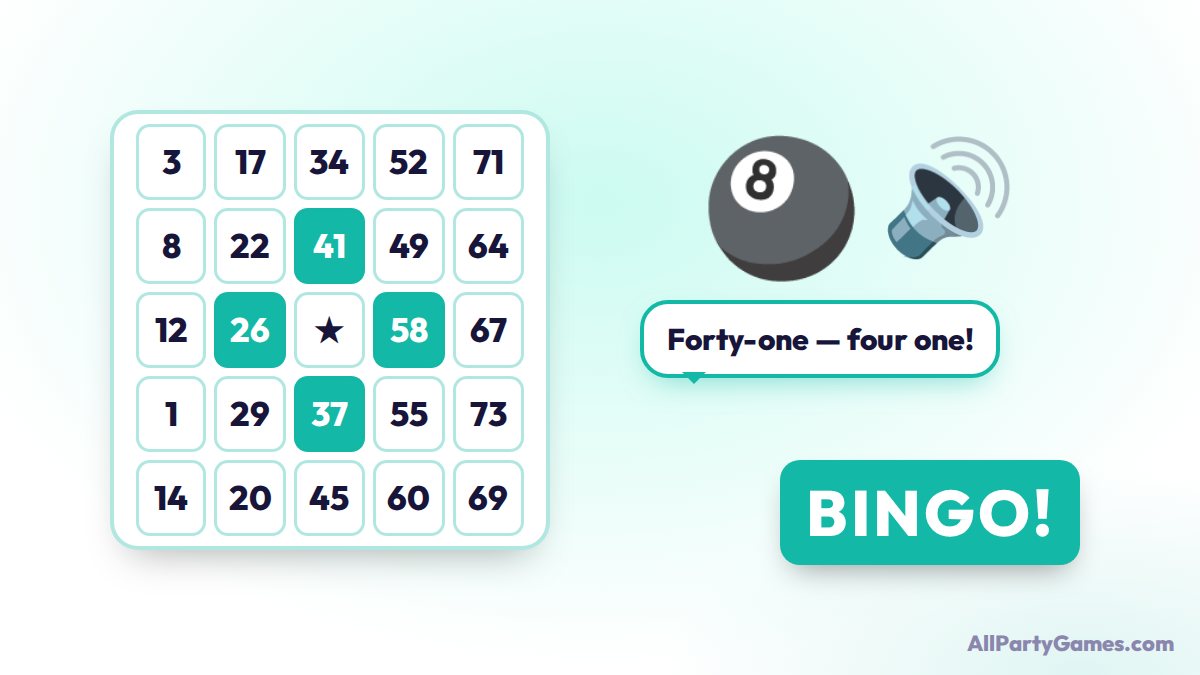
- Read each number twice, digit by digit: "forty-one — four, one".
- Keep the called-number board visible for claim checks.
- Small prizes for the early patterns keep everyone in until the full house.
Play Tambola Number Caller now — free, no sign-up
A Tambola / Housie number caller: random numbers from 1 to 90, a board showing called numbers, auto-call with a timer and the classic call-outs. Perfect for kitty parties and family events.
Frequently asked questions
Where did bingo come from?
From the Italian lottery Il Gioco del Lotto d'Italia, played from about 1530. It spread to France as Le Lotto in the eighteenth century, was used in nineteenth-century German schools to teach multiplication and spelling, and became a carnival game in 1920s America.
What is the difference between Bingo, Tambola and Housie?
Mostly the ticket. Tambola (India) and Housie (Britain, Australia, New Zealand) use a 90-number ticket of three rows with five numbers each; American bingo uses a 75-number 5×5 card with a free centre. The calling and the prizes work the same way.
What are the traditional bingo calls?
British callers have nicknames for every number — "two little ducks" for 22, "legs eleven", "top of the shop" for 90. Tambola callers in India use their own: "Kelly's eye" for 1, "dancing queen" for 17, "two fat ladies" for 88.