Rock Paper Scissors: History and Strategy
Rock paper scissors was described in a Ming-dynasty book as dating from the Han dynasty, became jan-ken in Japan and reached the West in the 1920s. The history, the rules, why it is fair, and the psychology that helps you win.
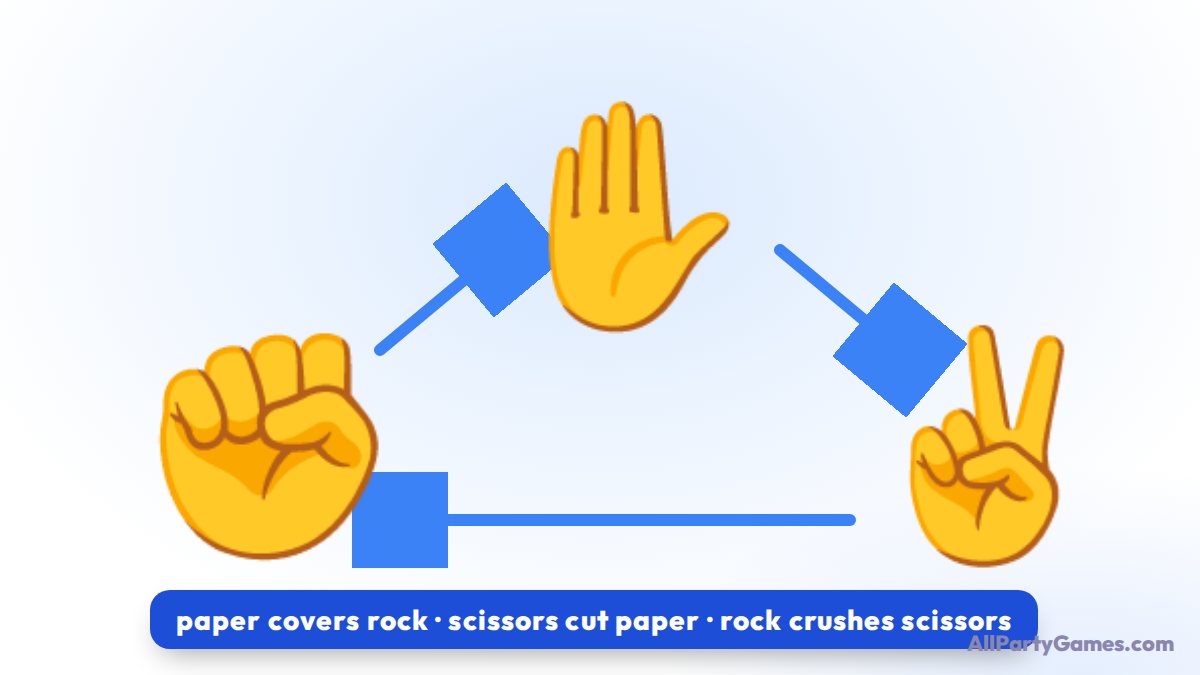
Rock, paper, scissors — shoot. The fastest fair decision in the world settles who goes first, who does the dishes and, at organised championships, who takes home a cash prize. It is also two thousand years old.
Where does rock paper scissors come from?
The game began in China. The Ming-dynasty writer Xie Zhaozhe, writing around 1600 in the Wuzazu, recorded a hand game called shoushiling that he said dated back to the Han dynasty (206 BCE–220 CE). From China the "fist games" travelled to Japan, where a whole family of sansukumi-ken — three-way standoff games — flourished; the rock-paper-scissors form, jan-ken, emerged in the seventeenth century and by the late nineteenth century was the direct source of the game we play now. Increased contact with Japan carried it west in the early twentieth century: a 1924 letter to The Times described a hand game "possibly of Mediterranean origin, called 'zhot'", and by 1927 the game was well enough known to title a novel, Scissors Cut Paper. The World Rock Paper Scissors Society ran professional championships from 2002 to 2009, the last of them in Toronto on 14 November 2009.
What you need
- Two hands. For a whole-room event, our Rock Paper Scissors Tournament builds a knockout bracket for up to 32 players with a 3-2-1 countdown, and Rock Paper Scissors plays against the computer with a best-of-three score.
How to play
- Face your opponent and pump a fist three times in time together.
- On the third beat, reveal your shape: rock (closed fist), paper (flat hand) or scissors (index and middle finger).
- Rock crushes scissors. Scissors cut paper. Paper covers rock.
- Same shape? Draw — throw again.
- Play best of three for decisions and best of five for arguments.
Why it is fair — and how to win anyway
Each shape beats one, loses to one and draws with itself, so a perfectly random player cannot be beaten. Nobody is perfectly random. Beginners throw rock first more often than chance suggests, so open with paper against a new opponent. Players who just lost tend to switch to the shape that would have beaten the throw that beat them; players who just won often repeat. And almost nobody throws the same shape three times running — so after two rocks, expect a change. Announce your throw out loud ("I'm going rock") and about half of people will assume you are bluffing.
Variations
- Best of five with a countdown for tournaments.
- Rock paper scissors lizard Spock — five shapes, fewer draws.
- Whole-body RPS — jump into the shape.
- Group elimination — everyone throws; the majority shape loses.
Tips for hosts
- Agree "shoot on three" or "after three" before the first throw — most disputes come from this.
- Use a screen countdown so everyone throws together.
- For a tournament, seed the draw at random and give the final a best-of-five.
Play Rock Paper Scissors now — free, no sign-up
Play Rock Paper Scissors against the computer with animated hands, a best-of-five score and instant results. Or use it as a two-player referee.
Frequently asked questions
Where does rock paper scissors come from?
From China. A Ming-dynasty writer, Xie Zhaozhe, recorded around 1600 that the hand game "shoushiling" dated back to the Han dynasty (206 BCE–220 CE). It travelled to Japan, where "jan-ken" — the direct ancestor of the modern game — developed in the seventeenth century.
When did it reach Europe and America?
In the early twentieth century, through contact with Japan. The first English-language description found so far is a 1924 letter to The Times; by 1927 the game was familiar enough to give a novel its title, "Scissors Cut Paper".
Is there a best move?
In theory no — each shape wins, loses and draws equally. In practice people are predictable: inexperienced players open with rock more often, and losers tend to switch to whatever would have beaten the last winning throw.