Memory Match: How to Play Concentration and Where It Came From
The pairs game has as many names as countries — Concentration, Pelmanism, Pexeso, Memory. Where the names come from, the rules, why it is good for children and adults, and strategies that really improve your score.
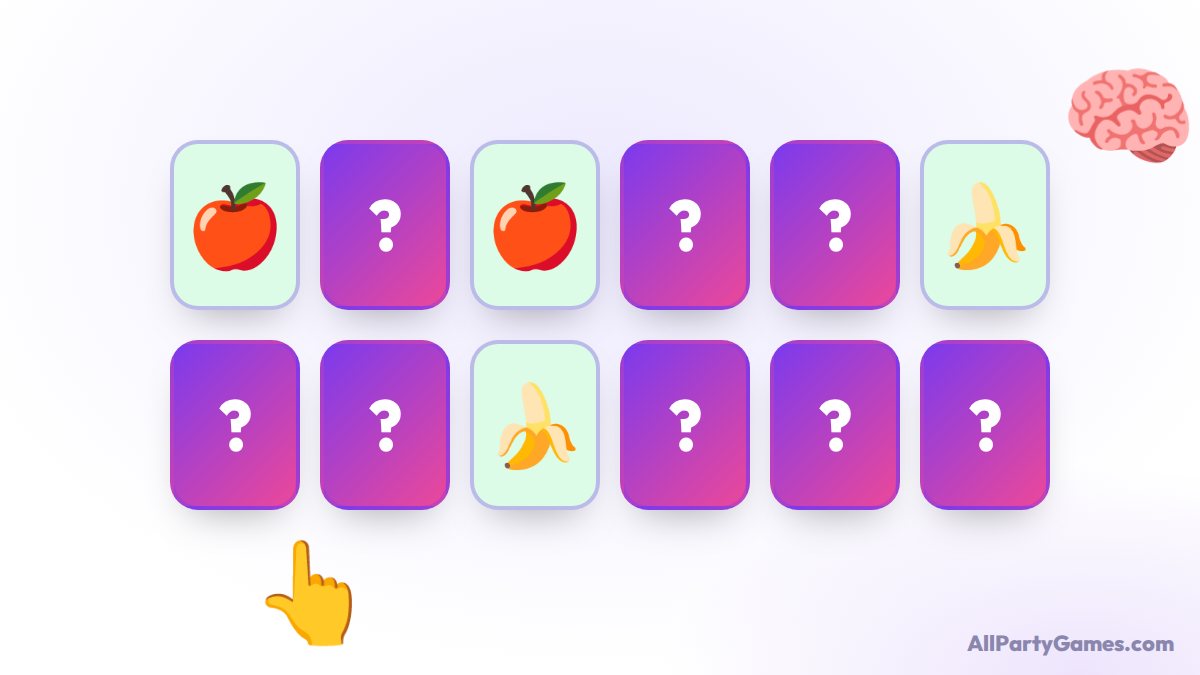
Cards face down, two flips per turn, find the pairs. The memory game is the rare pastime that works for a three-year-old, a grandparent and a bored commuter, and it is one of the few games where the youngest player is often the favourite.
Where does the memory game come from?
Matching games are as old as playing cards, but the names tell the story. In much of the English-speaking world the game is Concentration — also the name of a long-running American television quiz based on it. In Britain it was long called Pelmanism, after the Pelman Institute of London, whose "Pelmanism" mind-training system, devised by William Joseph Ennever in the 1890s and later taught through overseas institutes from Melbourne to Calcutta, promised to strengthen the memory "just as physical training strengthened your body"; a card game that drilled the same faculty naturally borrowed the name. Czech and Slovak families know it as Pexeso; Germans and many others simply as Memory, after the boxed picture-card editions of the 1950s and 60s that turned it into a children's classic.
What you need
- Any set of matching pairs — a double deck of cards, picture cards, or our Memory Match with emoji pairs in Kids, Easy, Medium and Hard grids, move and time tracking and a saved best score.
How to play
- Shuffle the pairs and lay every card face down in a grid.
- On your turn, turn over two cards so everyone can see them.
- A match: keep the pair (or score it) and take another turn.
- No match: turn both back over in the same places. Next player.
- When the grid is empty, the most pairs wins. Solo, race the clock and count your moves.
How to get better
- Name the position out loud in your head: "banana, second row, far right".
- Turn over an unknown card first; only then choose your second card, which you may already know.
- Scan the whole grid after every turn — other players' flips are free information.
- Play the corners and edges first; they are easier to remember than the middle.
Variations
- Kids grid — six pairs, big cards.
- Hard grid — fifteen pairs of look-alike emoji.
- One flip — if the first card is a match with a known card, you may claim it with a single flip.
- Word pairs — a word and its picture, a capital and its country, for classrooms.
Tips for hosts
- Let the youngest go first.
- Play three grids and add up the pairs for a fairer contest.
- Pass the phone for a head-to-head: same grid, fewest moves wins.
Play Memory Match now — free, no sign-up
Play Memory Match online: flip cards to find matching emoji pairs with Kids, Easy, Medium and Hard levels, move and time tracking, scores and a best-score record. Solo or pass-the-phone.
Frequently asked questions
Why is the memory game called Pelmanism?
The name was borrowed from a memory-training course. The Pelman Institute in London taught "Pelmanism", a mind-training system devised by William Joseph Ennever in the 1890s, and the card game took the name because it exercises the same skill.
What is the best strategy?
Remember positions, not just cards: say the location to yourself ("apple, top left"). Flip a card you have not seen first, and your second card second, so a new card never reveals a pair to your opponent.
Is it good for children?
It is one of the best early games there is — it builds concentration, working memory and turn-taking, and a four-year-old can beat an adult at it, which never stops being satisfying.