Charades: History, Rules and Hand Signals
Charades began as a literary riddle in 18th-century France, became an acted parlour game in the 19th century and appears in Vanity Fair and Jane Eyre. The history, the standard hand signals, the rules and a hosting guide.
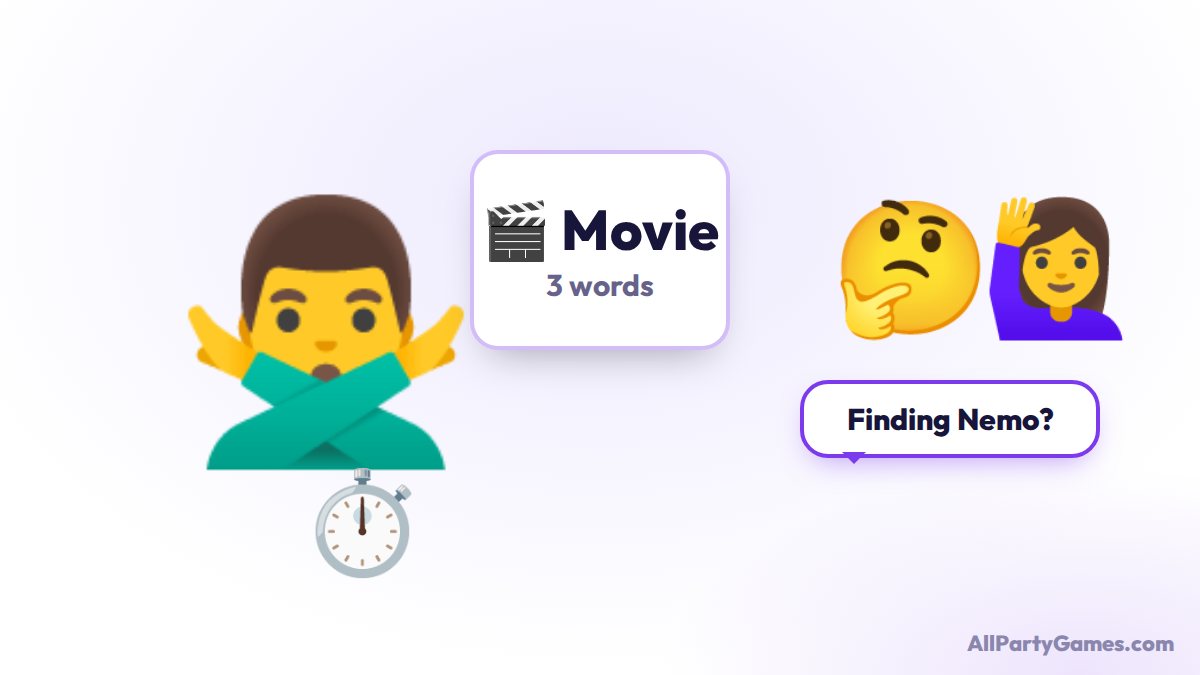
A player stands up, cranks an imaginary camera, holds up three fingers and starts swimming. "Finding Nemo!" — and the room erupts. Charades is two hundred years old and has never needed an update, because acting out a title with no words is exactly as funny now as it was in a Regency drawing room.
Where does charades come from?
The word arrived in English from French in the second half of the eighteenth century, when a charade was a literary riddle: a poem or prose puzzle whose answer was a word built syllable by syllable. Written charades were printed in magazines, painted on folding fans and composed by the fashionable — Jane Austen wrote one whose answer is "hemlock". In the early nineteenth century the French began to perform them instead of writing them, and the acted charade crossed the Channel with the English aristocracy. Thackeray's Vanity Fair and Charlotte Brontë's Jane Eyre both contain elaborate acted-charade scenes. By the First World War the acted version had become the most popular form, and the game took its short modern name. The performances were so gloriously amateurish that "a charade" came to mean any obvious pretence.
What you need
- Cards with titles or phrases and a timer — our Charades page supplies both, with movie, book, song, animal, action and kids categories and a team scoreboard.
- Two teams and room to move.
How to play charades
- Split into two teams and agree a timer, usually sixty seconds.
- The actor takes a secret card. On the screen version, only the actor looks.
- The actor signals the category and the number of words, then mimes. No words, no sounds, no pointing at objects in the room.
- Teammates shout guesses. The actor nods or waves them on.
- A correct guess before the timer scores a point. Teams alternate until everyone has acted; highest score wins.
The standard signals
- Movie — crank an old-fashioned camera.
- Book — open your hands like a book.
- Song — mime singing into a microphone.
- TV show — draw a rectangle in the air.
- Number of words — hold up that many fingers; then tap fingers on your arm for which word you are acting.
- Syllables — fingers laid on your forearm.
- Sounds like — tug your earlobe.
- Small word (a, the, of) — pinch finger and thumb.
- Longer / shorter — pull your hands apart or push them together.
- Correct! — tap your nose and point at the guesser.
Variations
- Reverse charades — the whole team acts and one player guesses.
- Animal charades for young children (try Animal Charades).
- Movie charades — titles only, Hard level for film buffs (Movie Charades).
- Acting challenge — act an emotion, a character and a situation at once (Acting Challenge).
Tips for hosts
- Teach the signals with one demo round before scoring.
- Let the shyest players guess before they act.
- Ban the phrase "it is a famous one" — it never helps.
- Keep a "skip" rule: one per team per game.
Play Charades now — free, no sign-up
Play charades online with a secret word generator and round timer. Categories: movies, animals, actions, objects, famous people and kids. Show the actor, hide, start the clock.
Frequently asked questions
What are the standard charades signals?
Movie: crank an old camera. Book: open your palms like a book. Song: pretend to sing. TV show: draw a rectangle. Number of words: hold up fingers. Which word: tap that many fingers on your arm. Syllables: fingers on your forearm. "Sounds like": tug your earlobe. Longer/shorter: pull hands apart or together. On the nose: tap your nose when a guess is exactly right.
Can you make sounds in charades?
No — that is the whole challenge. Clapping, humming and mouthing words are all out. Facial expressions and props from your own body are fine.
How many people do you need?
Four is the minimum for two teams; six to twelve is ideal. With very large groups, play in three or four teams and rotate.